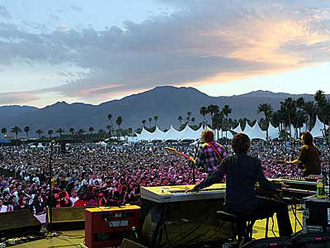
It’s that time of year—the hype for Coachella Valley Music and Arts Festival 2011 has arrived! Rumors of scheduled artists and headliners have tainted the web. Over 10,000 message threads and 400,000 individual posts occupy the official Coachella Message Board alone. Line-up wish lists from fans take up countless independent blog sites as well. While the actual 2011 artist lineup will not be released until the end of January or beginning of February, the history of the music festival assures festival fanatics that this year’s will be nothing less than sensational.
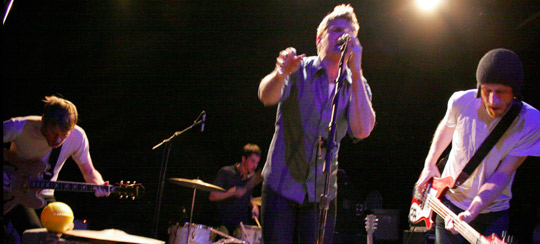
Click Read More to see Videos of some Great Live Performances
In a time when the music industry is constantly worrying about, questioning and adapting to changes in the way that people acquire and listen to music, there is one thing that hasn’t changed. The power and draw of a great live performance.
Bands like Nine Inch Nails and Radiohead don’t need to fear declining physical album sales because of two things: 1) these bands are leading the way by adapting to the digital age of music and 2) These bands know that they have a team of fans that will fight snow and storm to get to their live shows.
These bands have established their reputation by writing great music and putting on shows that draw crowds in. Whether they incorporate leaps in live music technology—like on the last Nine Inch Nails Tour where there was a sheet of lights that would switched on and off in reaction to the movements by the members of the band—or if they strip back the flashiness and allow their songs to communicate in a simple and humble manner. The key is create an atmosphere that will connect with the fans and get them excited.
Live music is incredibly powerful—seeing the strain and the emotion that a musician puts into the music can take a song from enjoyable to meaningful. Live music can inspire people, change ones day, change the way one feels and, by doing so, change lives. When one watches a live performance by a great band, there is a feeling like nothing else that overtakes a person. If you haven’t felt the shiver that runs down ones spine or a wave of happiness that makes you want to move then you have been going to the wrong performances. (Also, there are some great videos about the power of music at whymusicmatters.org I suggest the video about Willie Johnson)
So what is my entirely unprofessional and terribly biased advice to the music industry and to musicians in general. It’s the same advice I would give to any business: focus on doing what you do well. In the case Musicians: focus on writing and playing your music well. Allow your music to connect with your fans during your live performances and your fans will take care of marketing and buying the music, tickets and merchandise.
That said, I wanted to share a few of my favorite live performances as models.
Click Read More to see Videos of these Live Performances
Read More… Post Comment
For all you peeps who don’t have the attention to read full articles; here’s the low-down on the new digital music file MusicDNA:
- Norwegian developer Dagfinn Bach, who worked on the first MP3 player in 1993, and Karlheinz Brandenburg, the inventor of the MP3, revealed the “Music DNA†files at Cannes’ Midem music conference.
- The “MusicDNA†file will be able to update with new information whenever the file is activated. “We can deliver a file that is extremely searchable and can carry up to 32GB of extra information in the file itself, and it will be dynamically updatable so that every time the user is connected, his file will be updated ,†Bach said. Update examples would include - blog posts, tweets, music, lyrics, videos, artwork, tour dates, etc.
- The information given with the legally downloaded “MusicDNA” files will update automatically, but pirated files will remain static.
- There will be a beta launch in spring. If all goes well with the beta launch, the full roll out of the “MusicDNA†files is expected summer 2010.
- Independent labels including UK-based Beggars Group – home of Arctic Monkeys and Radiohead – as well as Tommy Boy Entertainment and Delta records in the US are on board, though no major labels yet.
- Each “MusicDNA” track will likely cost more than $1.29 - what iTunes is charging for their newer tracks.
“Out of a rusted old VW Beetle we are making a Ferrari,†said Bach Technology’s Stefan Kohlmeyer. “We are taking an existing idea, giving the end user a lot more and making that file much more valuable — like transforming a tiny house into a huge villa.†Good stuff.
Permalink Post Comment
So many artists, record labels, and management companies are struggling to adapt with the industry online. The ones who have not adapted have collapsed in on themselves, but those adapting are trying to stay afloat in what we can call the new music economy (coined by Greg Rollett of genyrockstars.com).
One of the biggest “issues” that music companies are having in the new music economy is piracy and unauthorized copying. As Andrew Dubber of New Music Strategies bluntly puts it:
The single most effective way to stop people from copying your music is to stop making music. If that’s not an option (and why would it be?) then accepting that this is the world in which we live is a good start towards successfully negotiating the new media environment.
This is the only way selling music works:
Fans will Hear—> Like—> Buy your music
I could explain this in my own words, but instead I’ll paste in this reference from a blog post by Andrew Dubber to explain it. This explains exactly why you need to quit worrying about piracy to survive in the new music economy:
Music is pretty much unique when it comes to media consumption. You don’t buy a movie ticket because you liked the film so much, and while you might buy a book because you enjoyed reading it so much at the library, typically you’ll purchase first, then consume…
But music is different - and radio proves that. By far the most reliable way to promote music is to have people hear it. Repeatedly, if possible - and for free. After a while, if you’re lucky, people get to know and love the music. Sooner or later, they’re going to want to own it…
But either way - whether it’s a pop tune, a heavily political punk album, or an experimental, avant-garde suite - the key is very simple: people have to hear music, then they will grow to like it, and then finally, if you’re lucky, they will engage in an economic relationship in order to consume (not just buy and listen to) that music…
That’s the order it has to happen in. It can’t happen in any other order. There’s no point in hoping that people will buy the music, then hear it, then like it. They just won’t.
To read the rest of the article, click ‘Read More…’
Read More… Post CommentCategories
-
73 POSTS
-
62 POSTS
-
57 POSTS
-
30 POSTS
-
30 POSTS
-
24 POSTS
-
25 POSTS
-
20 POSTS
-
20 POSTS
-
19 POSTS
-
16 POSTS
-
16 POSTS
-
15 POSTS
-
14 POSTS
-
14 POSTS
Popular Posts
Archives
-
5 POSTS
-
7 POSTS
-
6 POSTS
-
8 POSTS
-
9 POSTS
-
16 POSTS
-
5 POSTS
-
8 POSTS
-
9 POSTS
-
6 POSTS
-
9 POSTS
-
9 POSTS
-
15 POSTS
-
7 POSTS
-
13 POSTS
-
4 POSTS
-
9 POSTS
-
11 POSTS
-
19 POSTS
-
8 POSTS
-
11 POSTS
-
8 POSTS
-
15 POSTS
-
8 POSTS
-
4 POSTS
-
7 POSTS
-
13 POSTS
-
21 POSTS
-
12 POSTS
-
1 POST
-
4 POSTS
-
1 POST
Authors
-
58 POSTS
-
44 POSTS
-
44 POSTS
-
18 POSTS
-
17 POSTS
-
17 POSTS
-
9 POSTS
-
8 POSTS
-
7 POSTS
-
7 POSTS
-
6 POSTS
-
5 POSTS
-
5 POSTS
-
4 POSTS
-
4 POSTS
-
4 POSTS
-
4 POSTS
-
4 POSTS
-
3 POSTS
-
2 POSTS
-
2 POSTS
-
2 POSTS
-
2 POSTS
-
1 POST
-
1 POST
-
1 POST
-
1 POST